
Marketing success is often measured by numbers such as revenue, conversions, and return on investment. While these metrics are important, they usually tell you what has already happened rather than what is likely to happen next. Businesses that rely only on historical results often miss opportunities to improve performance before problems affect revenue.
This is why understanding leading indicators is essential for modern marketers. Leading indicators provide early signals about future performance, while lagging indicators measure outcomes after they occur. Together, they create a more complete view of marketing effectiveness and support smarter decision-making.
Organizations that balance both types of metrics can optimize campaigns more effectively, allocate budgets with greater confidence, and build sustainable growth strategies based on actionable insights rather than assumptions.
What Are Leading and Lagging Indicators?
Leading indicators are predictive measurements that help forecast future outcomes. They measure activities or behaviors that influence results before those results become visible.
Lagging indicators, on the other hand, evaluate completed outcomes such as revenue, customer acquisition, or overall campaign performance.
Common examples include:
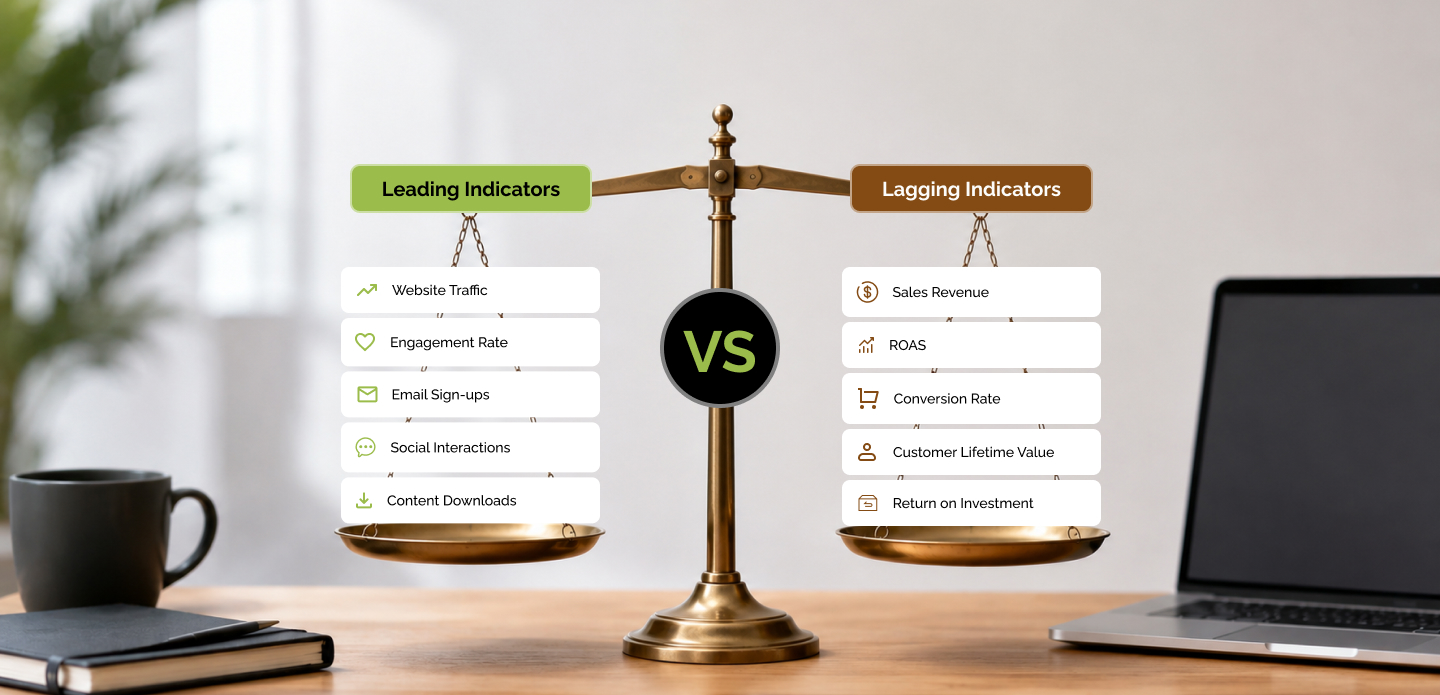
- Leading indicators: Website traffic quality, email open rates, click-through rates, engagement levels, qualified leads, and content interactions.
- Lagging indicators: Revenue, completed sales, customer lifetime value, return on ad spend, and total conversions.
- Leading indicators help marketers make proactive adjustments before campaigns underperform.
- Lagging indicators validate whether strategic decisions produced the desired business outcomes.
- Successful organizations monitor both to create a balanced measurement framework.
- Relying exclusively on one type of indicator creates blind spots that affect decision-making.
According to guidance from the National Institute of Standards and Technology (NIST), effective performance measurement depends on selecting metrics that support organizational objectives and continuous improvement. Marketing performance follows the same principle by combining predictive and outcome-based measurements.
Why Leading Indicators Matter More Than Ever
Digital marketing changes quickly. Customer behavior, search algorithms, advertising costs, and competitive activity evolve continuously.
Waiting until revenue declines before taking action often means opportunities have already been lost.
Leading indicators provide earlier visibility into campaign performance, allowing marketers to optimize strategies before negative outcomes occur.
For example, declining click-through rates may indicate messaging problems long before conversion numbers begin to decrease. Similarly, lower engagement with landing pages may reveal user experience issues that eventually reduce sales.
Businesses that consistently monitor predictive metrics can respond faster, improve campaign efficiency, and strengthen long-term results.
Building a Balanced Marketing Measurement Strategy
The most effective marketing teams do not prioritize one type of metric over the other.
Instead, they combine predictive indicators with outcome-based measurements to understand both current performance and future potential.
Organizations focused on growth marketing often evaluate how early engagement metrics influence eventual revenue generation. This balanced approach improves forecasting while supporting continuous optimization.
Research published by Harvard Business Review explains that balanced measurement systems help organizations connect day-to-day activities with long-term strategic objectives. Marketing measurement becomes significantly more valuable when both leading and lagging indicators are evaluated together.
Rather than reacting to historical performance, marketers gain the ability to improve future outcomes proactively.
Leading Marketing Metrics Every Business Should Monitor
The specific metrics businesses monitor depend on objectives, channels, and customer journeys. However, several predictive measurements consistently provide valuable insights.
- Organic search traffic quality
- Qualified lead generation
- Landing page engagement
- Email click-through rates
- Customer retention signals
- Content interaction rates
These marketing metrics often reveal emerging trends before they affect revenue or customer acquisition.
Businesses investing in professional Analytics & Data-Driven Optimization services frequently use these indicators to identify opportunities for continuous improvement and more informed decision-making.
Monitoring these signals consistently allows marketing teams to optimize campaigns while reducing unnecessary spending.
Understanding the Role of Conversion Tracking
Reliable conversion tracking connects marketing activities with measurable business outcomes.
Without accurate tracking, businesses struggle to determine which campaigns generate meaningful value and which require improvement.
Conversion tracking should extend beyond completed purchases. It should also monitor intermediate actions such as form submissions, product demonstrations, newsletter subscriptions, and qualified inquiries.
When these activities are evaluated alongside leading indicators, marketers gain deeper visibility into customer behavior throughout the buying journey.
Accurate attribution improves resource allocation while supporting more effective campaign optimization.
Why Performance Optimization Depends on Context
Raw numbers rarely provide complete answers.
Strong performance optimization requires understanding why metrics change rather than simply observing that they changed.
For example, declining website traffic may appear negative at first. However, if traffic quality improves and qualified leads increase, overall marketing performance may actually be improving.
Context allows marketers to interpret data correctly and avoid making decisions based on incomplete information.
Organizations that combine analytical insights with business objectives consistently make more effective strategic decisions.
Digital Marketing Requires Continuous Measurement
Modern digital marketing campaigns operate across multiple platforms, channels, and customer touchpoints.
Search engines, email campaigns, paid advertising, content marketing, and social media all contribute different types of performance data.
Businesses using professional Search Engine Optimization services often monitor leading indicators such as keyword visibility, search impressions, click-through rates, and user engagement alongside conversion-focused metrics.
Evaluating these measurements together creates a more comprehensive understanding of marketing effectiveness.
Continuous monitoring also allows organizations to adapt more quickly as customer behavior changes.
Turning Metrics into Better Decisions
Collecting data alone does not improve performance.
The true value of measurement comes from translating insights into action.
For example, this guide on GA4 Made Simple: Finding the Metrics That Actually Matter explains how businesses can identify meaningful performance indicators instead of becoming overwhelmed by unnecessary data.
Organizations that prioritize actionable insights consistently outperform those focused solely on reporting numbers.
Effective measurement should guide optimization rather than simply document results.
Looking Beyond Revenue Metrics
Revenue remains one of the most important business outcomes, but it should not be the only measurement guiding marketing decisions.
According to insights shared by Forbes, leading and lagging indicators work together to provide a more complete understanding of organizational performance.
Marketing teams that evaluate predictive metrics alongside business outcomes gain greater visibility into future opportunities while reducing strategic uncertainty.
This broader perspective supports smarter investments and more sustainable growth.
Conclusion
Understanding leading indicators allows marketers to move beyond simply measuring past performance. By combining predictive marketing metrics with outcome-focused measurements, businesses can improve forecasting, strengthen performance optimization, and make more informed strategic decisions.
Successful digital marketing depends on balancing early performance signals with long-term business outcomes. Organizations that consistently monitor both leading and lagging indicators will be better positioned to optimize campaigns, improve conversion tracking, and support sustainable growth marketing initiatives.
Rather than asking only what happened, modern marketers should also ask what today’s metrics reveal about tomorrow’s opportunities.