
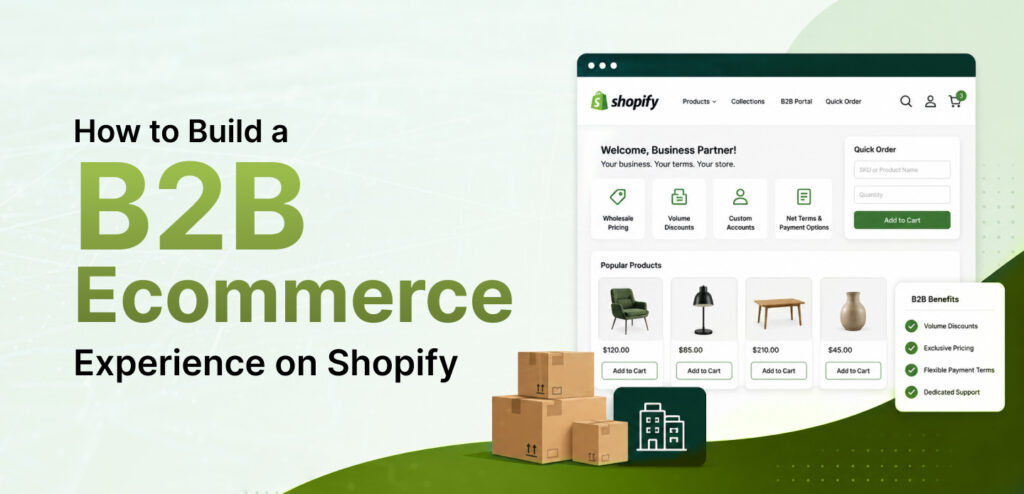
B2B ecommerce has evolved far beyond simply offering wholesale pricing online. Today’s business buyers expect the same convenience, speed, and personalization they experience when shopping as consumers. They want streamlined ordering, flexible payment options, accurate inventory information, and seamless account management.
For businesses using Shopify, creating a successful b2b ecommerce shopify experience requires more than launching an online store. It involves building an ecommerce ecosystem that supports complex purchasing workflows while maintaining a smooth and intuitive customer experience.
Whether you’re transitioning from traditional sales processes or expanding your digital presence, understanding the essential components of a B2B Shopify store can help you improve efficiency, strengthen customer relationships, and support long-term growth.
Understanding the Unique Needs of B2B Ecommerce
Unlike B2C stores, B2B ecommerce must accommodate business-specific purchasing requirements. Buyers often place larger orders, negotiate pricing, manage multiple users under one account, and expect personalized experiences tailored to their organization.
According to TechTarget, B2B transactions involve businesses selling products or services to other businesses rather than directly to consumers. These relationships typically involve longer purchasing cycles, multiple decision-makers, and more complex buying processes.
A successful Shopify implementation should support these unique requirements while simplifying the purchasing journey for customers.
Essential Features of a High-Performing B2B Shopify Store
Building an effective B2B ecommerce experience requires functionality that extends beyond standard ecommerce features.
- Customer-specific pricing and catalogs
- Company account management
- Flexible bulk ordering capabilities
- Real-time inventory synchronization
- Multiple payment options
- Streamlined reorder functionality
These capabilities improve purchasing efficiency while creating a more personalized experience for business customers.
Organizations investing in professional Ecommerce Development services often customize Shopify environments to support industry-specific workflows and long-term scalability.
Choosing the right feature set from the beginning helps reduce operational complexity as the business grows.
Why Inventory Synchronization Is Critical
One of the most important aspects of a B2B ecommerce platform is maintaining accurate inventory information.
Business buyers often place high-volume orders that depend on product availability. Inaccurate inventory data can result in delayed shipments, canceled orders, and damaged customer relationships.
Effective inventory synchronization ensures product availability remains consistent across warehouses, ERP systems, sales channels, and supplier networks.
When inventory updates occur in real time, businesses reduce manual errors while improving operational efficiency and customer satisfaction.
This becomes increasingly important as product catalogs expand and order volumes increase.
Choosing the Right Shopify Integrations
Shopify provides a flexible ecosystem that allows businesses to extend platform functionality through integrations.
The most valuable Shopify integrations often include ERP systems, CRM platforms, accounting software, shipping providers, customer support tools, and marketing platforms.
Rather than treating integrations as optional enhancements, businesses should view them as essential components of an efficient digital infrastructure.
Well-designed integrations eliminate duplicate data entry, improve workflow consistency, and create a connected operational environment.
Selecting integration partners should be based on long-term business needs rather than short-term convenience.
Ecommerce Automation Improves Efficiency
As B2B operations scale, manual processes become increasingly difficult to manage.
Ecommerce automation helps streamline repetitive activities while improving operational consistency.
- Automated order processing
- Customer account approvals
- Inventory updates
- Invoice generation
- Email notifications
- Workflow management
These automation capabilities reduce administrative workloads while allowing teams to focus on customer relationships and strategic growth.
Businesses implementing AI Integration & Automation solutions often combine automation with existing ecommerce systems to improve operational efficiency across multiple business functions.
Automation also helps reduce human error while supporting faster response times throughout the purchasing process.
Selecting Secure Payment Gateways
Business customers frequently require greater payment flexibility than traditional online shoppers.
Supporting multiple payment gateways allows businesses to accommodate different purchasing preferences while simplifying financial operations.
Many B2B organizations require options such as purchase orders, invoicing, net payment terms, corporate credit cards, or integrated financing solutions.
Choosing secure and reliable payment providers helps build trust while supporting smoother checkout experiences.
Payment flexibility can become a competitive advantage, particularly when serving larger organizations with established procurement processes.
Designing an Experience That Supports Business Buyers
Technology alone does not create successful B2B ecommerce experiences.
The overall user experience should simplify product discovery, ordering, account management, and customer support.
Clear navigation, intuitive search functionality, personalized dashboards, and simplified checkout processes contribute to stronger customer satisfaction.
Businesses should also prioritize responsive design so purchasing experiences remain consistent across desktop and mobile devices.
A well-designed interface reduces friction while encouraging repeat purchases and stronger customer loyalty.
Building a Scalable Ecommerce Solution
Successful B2B stores should support both current operations and future growth.
Scalability involves more than adding products or increasing server capacity. Businesses must ensure their systems, workflows, integrations, and infrastructure can accommodate expanding customer bases and transaction volumes.
According to guidance from the U.S. Small Business Administration, sustainable business growth depends on developing effective marketing and sales strategies alongside operational improvements.
A scalable ecommerce platform supports these broader business objectives by creating a flexible foundation for long-term expansion.
Businesses seeking comprehensive ecommerce solutions should evaluate technology choices based on future requirements rather than immediate needs alone.
Supporting Long-Term Growth Through Continuous Optimization
Launching a Shopify store is only the beginning.
Ongoing analysis, testing, and optimization help businesses improve customer experiences while increasing operational efficiency.
Performance metrics, customer behavior, conversion rates, and order workflows should be reviewed regularly to identify improvement opportunities.
For example, this guide on How to Grow an Ecommerce Business explores strategies for scaling ecommerce operations through continuous optimization and customer-focused improvements.
Small enhancements made consistently often produce significant long-term business results.
The Future of B2B Ecommerce on Shopify
B2B ecommerce continues to evolve as customer expectations become increasingly sophisticated.
Insights shared by Forbes highlight how businesses are embracing digital innovation to improve customer experiences and remain competitive in changing markets.
Organizations that invest in scalable technology, efficient workflows, automation, and customer-centric experiences will be better positioned to adapt as ecommerce continues to evolve.
Rather than viewing Shopify as simply an online storefront, businesses should consider it a platform capable of supporting complex digital commerce strategies.
Conclusion
Building a successful b2b ecommerce shopify experience requires thoughtful planning, scalable technology, and a deep understanding of business customer expectations.
Features such as inventory synchronization, effective Shopify integrations, ecommerce automation, secure payment gateways, and flexible ecommerce solutions work together to create efficient purchasing experiences that strengthen customer relationships.
By combining the right technology with strategic optimization and continuous improvement, businesses can transform Shopify into a powerful B2B commerce platform that supports operational efficiency, customer satisfaction, and sustainable long-term growth.