
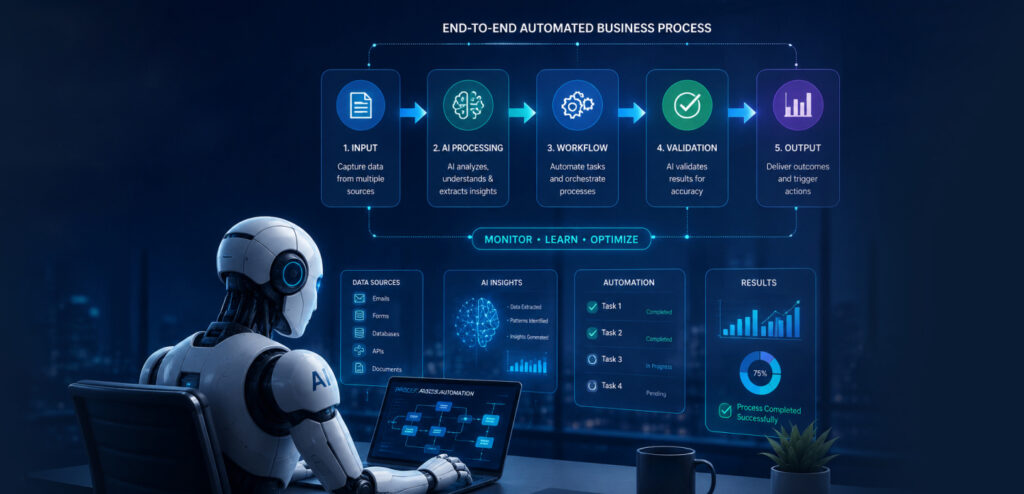
As businesses continue to embrace digital transformation, automation has evolved beyond handling isolated tasks. Today, organizations are increasingly adopting end to end business automation to connect entire workflows, eliminate repetitive manual processes, and improve operational efficiency across departments.
Artificial intelligence plays a central role in this shift by enabling systems to analyze data, make intelligent decisions, and execute complex workflows with minimal human intervention. Instead of automating individual activities, businesses are now creating connected operational ecosystems that improve productivity, reduce costs, and support long-term growth.
Building these automated environments requires thoughtful planning, strategic implementation, and continuous optimization. When executed effectively, AI-powered automation becomes a powerful driver of operational excellence rather than simply another technology investment.
What Is End-to-End Business Automation?
End to end business automation refers to the automation of complete business processes from initiation to completion. Rather than optimizing isolated tasks, organizations connect multiple systems, departments, and technologies into seamless workflows.
An automated process may begin with a customer inquiry, continue through data validation, order processing, inventory updates, invoicing, customer communication, and reporting without requiring manual intervention at each stage.
Research published by Springer highlights how intelligent process automation combines artificial intelligence with workflow technologies to improve organizational efficiency and decision-making.
The objective is to reduce operational friction while creating faster, more reliable business processes.
Key Benefits of AI-Powered Business Automation
Organizations implementing AI across complete workflows often experience improvements throughout their operations.
- Reduced manual effort across departments
- Faster decision-making and execution
- Improved operational consistency
- Lower administrative costs
- Enhanced customer experiences
- Greater scalability for future growth
These advantages make Business automation an important component of modern digital transformation strategies.
Businesses investing in AI Integration & Automation services frequently connect multiple operational systems to create intelligent workflows that improve efficiency while reducing repetitive work.
Rather than replacing employees, automation enables teams to focus on higher-value strategic activities.
How AI Process Automation Connects Business Systems
Many organizations already use separate software solutions for customer relationship management, finance, inventory, marketing, and customer support.
Without integration, these systems often require duplicate data entry and manual coordination.
AI process automation helps bridge these gaps by enabling information to move automatically between systems while triggering intelligent actions based on predefined conditions.
For example, a customer purchase can automatically update inventory, generate invoices, notify shipping providers, send confirmation emails, and update reporting dashboards.
This interconnected approach creates smoother operations while minimizing delays and human error.
Organizations benefit from greater visibility across departments while improving overall operational efficiency.
Digital Workflows Create Better Customer Experiences
Automation is not only about internal efficiency. It also improves the customer experience.
Well-designed digital workflows reduce response times, eliminate unnecessary delays, and ensure customers receive consistent communication throughout their journey.
From lead generation and onboarding to order fulfillment and customer support, automated workflows help businesses deliver reliable experiences at scale.
Customers increasingly expect fast responses and seamless interactions. Intelligent automation helps organizations meet those expectations while maintaining service quality as demand grows.
Businesses that optimize customer-facing workflows often improve both satisfaction and retention.
Process Optimization Should Come Before Automation
One of the most common implementation mistakes is automating inefficient processes.
Technology accelerates existing workflows, whether they are effective or flawed. Automating unnecessary steps often increases complexity rather than improving performance.
Before implementing AI, organizations should evaluate current operations and identify opportunities for process optimization.
- Eliminate redundant activities
- Simplify approval workflows
- Standardize business procedures
- Improve data quality
- Remove manual bottlenecks
- Define measurable performance goals
Optimizing processes before automation ensures technology supports efficient operations rather than reinforcing existing inefficiencies.
This preparation significantly improves long-term implementation success.
The Importance of AI Integration
Automation becomes significantly more valuable when systems communicate effectively.
Strong ai integration enables applications to exchange information, trigger workflows, and support coordinated decision-making across departments.
Businesses often integrate customer relationship management platforms, enterprise resource planning systems, ecommerce platforms, accounting software, and communication tools into unified operational environments.
Organizations implementing professional Digital Workers services frequently develop intelligent automation solutions that connect business systems, reduce repetitive manual tasks, and improve operational efficiency across departments.
Careful integration planning helps reduce complexity while supporting future scalability.
AI Governance and Responsible Implementation
As AI adoption increases, organizations must also consider governance, transparency, and responsible implementation.
According to guidance from the National Institute of Standards and Technology (NIST), trustworthy AI requires attention to reliability, safety, accountability, and risk management throughout implementation.
Businesses should establish governance practices that address data quality, privacy, security, compliance, and ongoing monitoring.
Responsible implementation helps organizations maintain stakeholder confidence while reducing operational risks.
Automation should support better decision-making rather than introducing unnecessary uncertainty.
Measuring the Success of Automated Processes
Successful automation initiatives rely on measurable outcomes rather than assumptions.
Organizations should monitor key performance indicators such as processing times, operational costs, customer satisfaction, workflow completion rates, and error reduction.
Regular analysis allows businesses to identify opportunities for further improvement while ensuring automation continues to align with changing business objectives.
Research available through arXiv highlights the growing importance of intelligent systems in supporting increasingly sophisticated business operations. Continuous evaluation helps organizations maximize these technological capabilities over time.
Automation should remain an evolving capability rather than a one-time implementation project.
Learning from Practical Automation Strategies
Many successful organizations begin automation gradually by focusing on high-impact processes before expanding across the business.
This phased approach reduces implementation risks while allowing teams to build expertise and confidence.
For businesses exploring automation opportunities, this guide on Workflow Automation: Boost Efficiency and Slash Costs provides practical insights into identifying workflows suitable for automation and improving operational performance.
Learning from proven implementation strategies often leads to more sustainable long-term results.
Conclusion
Building end to end business automation with AI is about far more than reducing manual work. It involves connecting people, systems, and processes into intelligent operational environments that improve efficiency, scalability, and customer experiences.
By combining ai business process automation, effective ai integration, optimized digital workflows, and continuous process optimization, businesses can transform fragmented operations into streamlined, data-driven ecosystems.
Organizations that approach automation strategically will be better positioned to improve productivity, adapt to changing market conditions, and achieve sustainable growth in an increasingly digital business landscape.