
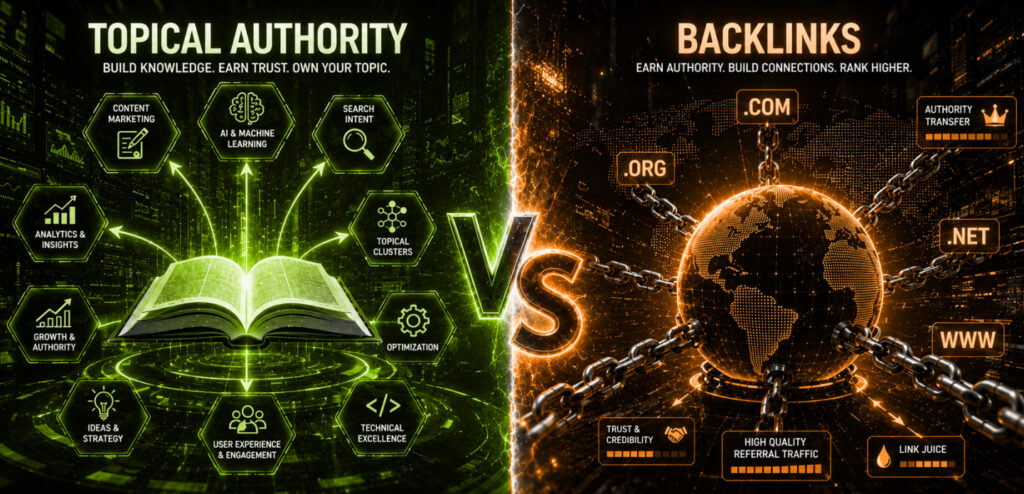
For years, backlinks were considered the most important ranking factor in search engine optimization. Businesses invested heavily in link building campaigns because acquiring high-quality links often resulted in improved rankings and increased traffic. While backlinks remain valuable, the evolution of search engines has changed the way websites are evaluated.
Today, search engines focus more heavily on expertise, relevance, context, and content depth. As a result, topical authority seo has become one of the most discussed concepts in modern search optimization.
The question many marketers and business owners ask is simple: what matters more today, backlinks or topical authority?
The answer is not as straightforward as choosing one over the other. Understanding how both contribute to search performance is essential for building a sustainable SEO strategy that improves rankings and long-term organic search visibility.
What Is Topical Authority in SEO?
Topical authority refers to a website’s demonstrated expertise and depth of knowledge within a specific subject area.
Rather than publishing isolated content pieces, authoritative websites create comprehensive resources that cover a topic from multiple perspectives. This approach helps search engines understand that the website is a reliable source of information.
The growing importance of context and topic relationships aligns with principles discussed by Wikipedia in its overview of semantic search. Modern search engines increasingly evaluate meaning, relationships, and user intent rather than relying solely on exact keyword matching.
As search technology evolves, websites that thoroughly address a topic often outperform competitors that publish limited or disconnected content.
Building authority requires consistency, relevance, and a strategic content framework.
Why Topical Authority Matters Today
Search engines are becoming increasingly sophisticated in how they evaluate content quality and expertise.
- Demonstrates subject matter expertise
- Supports stronger content relevance
- Improves internal linking opportunities
- Helps rank for related keyword variations
- Strengthens user trust and engagement
- Supports long-term organic growth
These benefits make topical authority seo a critical component of modern optimization strategies.
Rather than targeting individual keywords in isolation, successful websites create interconnected content ecosystems that address entire topics. This approach improves content discoverability while helping users find comprehensive answers to their questions.
Businesses investing in professional Content Marketing services often use topical clustering strategies to strengthen authority and improve visibility across broader search categories.
The Continuing Importance of Backlinks
Although topical authority has gained attention, backlinks remain an important ranking signal.
Backlinks act as endorsements from other websites. When reputable websites link to your content, search engines interpret those links as signals of trust and credibility.
The foundational role of backlinks can be traced back to Google’s original research paper from Stanford University, which introduced PageRank as a method for evaluating the importance of web pages based on link relationships.
Even today, backlinks help search engines discover content, assess credibility, and evaluate authority.
However, the role of links has evolved. Quantity alone no longer produces meaningful results. Search engines increasingly prioritize link quality, contextual relevance, and overall website trustworthiness.
This shift has reduced the effectiveness of manipulative link-building tactics that once dominated the SEO industry.
Why Backlinks Alone Are No Longer Enough
In earlier stages of SEO, websites could often achieve rankings primarily through aggressive link acquisition.
Today, that approach carries significant limitations.
A website with strong backlink profiles but weak content may struggle to maintain visibility because search engines place greater emphasis on user satisfaction and content quality.
Visitors expect comprehensive information, clear answers, and trustworthy experiences. If content fails to meet those expectations, rankings become difficult to sustain.
Modern algorithms evaluate a broader set of signals that include expertise, relevance, engagement, and content depth.
This evolution has made topical authority increasingly valuable as a complement to traditional link-building efforts.
The Relationship Between Topical Authority and Backlinks
Many SEO discussions present topical authority and backlinks as competing concepts. In reality, they work best together.
- Topical authority helps create content worth linking to
- Strong content naturally attracts relevant backlinks
- Backlinks reinforce trust signals
- Authority improves content discoverability
- Combined signals strengthen search visibility
- Both contribute to long-term SEO success
The strongest websites rarely rely on only one factor. Instead, they build comprehensive content ecosystems while earning high-quality backlinks through expertise and value creation.
This balanced approach aligns closely with how modern search engines evaluate credibility and relevance.
How Search Engines Evaluate Authority Today
The way search engines assess authority has expanded significantly over the years.
According to information from Britannica, search engines use complex systems to organize and retrieve information from the web. These systems increasingly focus on delivering the most useful and relevant content for users.
As a result, search engines evaluate multiple indicators of expertise rather than relying exclusively on link signals.
Content breadth, topical coverage, user engagement, site structure, internal linking, and contextual relevance all contribute to authority assessment.
Businesses seeking stronger rankings often combine Search Engine Optimization initiatives with content strategies designed to establish expertise across entire subject areas.
This integrated approach supports both search performance and user experience.
Building Topical Authority Without Ignoring Links
Organizations pursuing stronger search visibility should avoid treating topical authority and backlinks as separate objectives.
A practical approach begins with creating comprehensive topic clusters supported by a clear seo keyword strategy. Instead of publishing unrelated articles, businesses should focus on developing interconnected resources that address user questions throughout the customer journey.
For example, companies implementing a strong local seo strategy often create supporting content around local search optimization, customer acquisition, reputation management, and search visibility.
A useful example can be found in this guide on Building Content Pillars for SEO Strategy, which explores how structured content frameworks contribute to stronger authority and long-term ranking performance.
When content demonstrates expertise, attracting natural backlinks becomes significantly easier.
What Matters More in Modern SEO?
The reality is that neither topical authority nor backlinks should be viewed in isolation.
Topical authority has become increasingly important because search engines now prioritize expertise, relevance, and user satisfaction. However, backlinks remain valuable indicators of trust and credibility.
If forced to choose, many modern SEO professionals would argue that topical authority creates the foundation upon which sustainable rankings are built. High-quality backlinks amplify that authority rather than replace it.
Websites that focus exclusively on backlinks without developing expertise often struggle to maintain rankings over time.
The most effective strategy combines both elements within a cohesive SEO framework.
Conclusion
The debate between backlinks and topical authority seo reflects the broader evolution of search engines. While backlinks continue to influence rankings, content depth, expertise, and relevance have become increasingly important in modern seo.
Organizations that build strong topical coverage while earning high-quality seo backlinks position themselves for greater organic search visibility and long-term success.
Rather than choosing one over the other, businesses should focus on creating authoritative content ecosystems that naturally attract links and demonstrate expertise. In today’s search environment, the strongest SEO strategies are those that successfully combine both.