
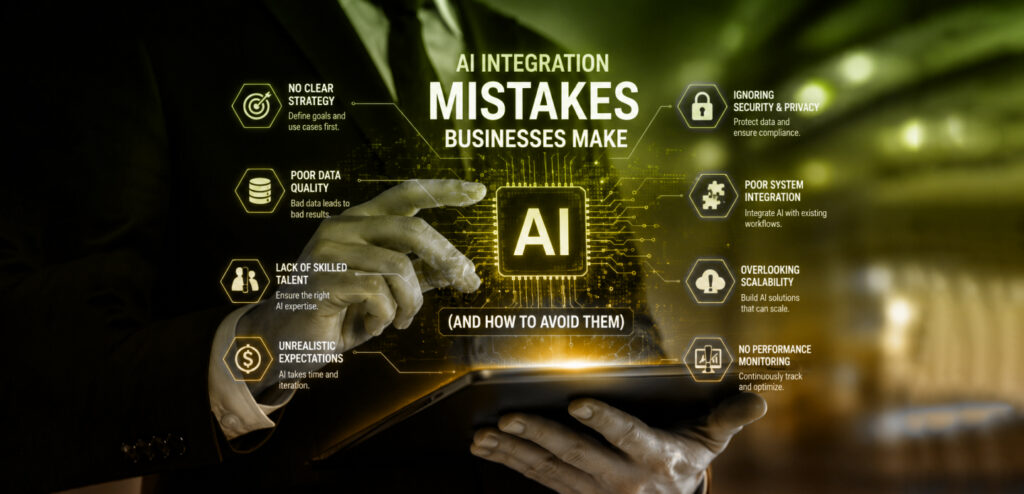
Artificial intelligence is no longer a future technology. It is a practical tool for improving efficiency, cutting costs and creating a competitive edge. Yet many organizations still struggle to get the results they expected from AI.
The problem is rarely the technology itself. It is usually poor planning, unrealistic expectations and avoidable mistakes. Successful AI integration for business takes more than deploying software: it requires alignment between goals, processes, people and technology.
This guide covers the seven most common AI integration mistakes, why they happen and how to avoid each one, so you can reduce costly delays, low adoption and the risk of digital transformation failure.
The Most Common AI Integration Mistakes at a Glance
- Starting without clear business objectives
- Automating broken processes
- Ignoring data quality
- Failing to prepare employees
- Overlooking scalability
- Treating AI as an isolated project
- Skipping governance, security and measurement
These mistakes create integration errors that hurt performance and delay return on investment. Research and commentary from sources such as MIT Sloan Management Review suggest many leaders focus on the technology while neglecting the organizational changes needed to support it.
Mistake #1: Starting Without a Clear Strategy
The absence of a defined strategy is one of the biggest causes of digital transformation failure. Many businesses adopt AI because competitors are doing it. Experimentation has value, but every AI initiative should support a measurable objective.
Without clear goals you cannot judge success, prioritize investments or align stakeholders.
How to avoid it
- Start with a specific problem: slow response times, manual reporting, high support volume, poor forecasting.
- Define a measurable target (hours saved, cost reduced, conversion improved).
- Choose a small, high-value first use case.
Businesses that invest in AI strategy and consulting often build stronger foundations because planning happens before technology is deployed.
Mistake #2: Automating Broken Processes
AI can improve workflows, but it cannot fix a fundamentally flawed process. If you automate an inefficient workflow, you simply get a faster version of the same problem.
How to avoid it
- Map how the work is done today and find bottlenecks.
- Simplify and fix the process first, or alongside the technology.
- Design the workflow around the outcome, not around the tool.
Good AI integration needs thoughtful workflow design, not automation for its own sake.
Mistake #3: Ignoring Data Quality
AI depends on data. Incomplete, inconsistent, duplicated or outdated data directly reduces model performance. Many AI implementation challenges come from data management problems, not from the algorithms.
How to avoid it
- Audit your data sources for accuracy, duplication and gaps.
- Assign ownership and set governance rules for how data is collected and updated.
- Make sure the data is accessible across the systems AI will use.
- Check privacy and consent requirements before using customer data.
Investing in data quality early reduces risk and builds confidence in AI-driven decisions.
Mistake #4: Failing to Prepare Employees
Technology adoption is ultimately a human challenge. People worry about changing workflows and the effect of automation on their roles. When communication and training are neglected, resistance slows adoption. Industry coverage, including TechTarget, regularly highlights how poor change management leads to setbacks.
How to avoid it
- Involve teams from the beginning.
- Explain how AI supports their work and what changes.
- Provide hands-on training and a clear way to give feedback.
- Name internal champions who can help colleagues.
Teams that understand the value of AI adopt it faster and use it better.
Mistake #5: Overlooking Scalability
Many businesses run an encouraging pilot and then struggle to scale it. Common AI scalability challenges include:
- Growing data volumes
- More users and wider adoption
- Additional system integrations
- Evolving compliance requirements
- Higher processing demands
- Increasing operational complexity
How to avoid it
- Ask early what happens at 10 times the volume.
- Choose architecture and vendors that can grow with you.
- Plan integration with your existing systems up front.
Organizations investing in AI integration and automation should evaluate long-term needs alongside immediate goals. Planning for expansion early usually reduces cost and complexity later.
Mistake #6: Treating AI as an Isolated Technology Project
AI should not sit apart from existing teams, systems and goals. When it is run as a standalone project, it rarely connects to measurable business outcomes. IBM and other major technology firms emphasize integrating AI into existing business operations rather than treating it as a separate investment.
How to avoid it
- Involve operations, IT, finance and the teams who will use the tool.
- Tie the project to a business KPI someone owns.
- Integrate with the tools your teams already use.
Mistake #7: Skipping Governance, Security and Measurement
AI that touches customer data, decisions or content needs rules. Without them you risk privacy problems, inconsistent output and no way to prove value.
How to avoid it
- Set policies for data use, privacy and acceptable AI use.
- Keep a human review step where errors are costly.
- Track results against your baseline: time saved, cost, accuracy, customer satisfaction.
- Review and improve regularly, since AI tools and risks change quickly.
How to Build a More Successful AI Integration Strategy
- Define goals tied to measurable outcomes.
- Evaluate workflows and fix inefficiencies first.
- Prepare your data and governance.
- Prepare your people with communication and training.
- Start small, prove value, then scale.
- Measure and optimize continuously.
It also helps to learn from other implementations. This guide on AI integration for business systems explores practical considerations for integrating AI into existing operations with minimal disruption.
The most successful organizations treat AI as an ongoing capability, not a one-time project.
AI Integration for Memphis Businesses
Memphis companies in logistics, healthcare, professional services and ecommerce often have the data and repetitive processes where AI can help most, such as scheduling, reporting, customer support and demand forecasting. If you sell online, see how AI fits into a marketplace in our guide to multi-vendor ecommerce platforms.
AI Integration FAQ
What are the most common AI integration mistakes?
Starting without clear goals, automating broken processes, ignoring data quality, not preparing employees, overlooking scalability, treating AI as an isolated project and skipping governance.
Why do AI projects fail?
Usually because of unclear objectives, poor data, weak adoption and a lack of integration with real business processes, rather than the technology itself.
How do I start AI integration for my business?
Pick one specific problem with a measurable outcome, check your data, run a small pilot with the team that will use it and measure results before scaling.
How long does AI integration take?
It depends on scope and data readiness. A focused pilot can take weeks, while enterprise-wide integration takes months or longer.
Get an AI Plan Before You Build
If you are planning to bring AI into your business, start with a clear roadmap. Talk to our team about AI consulting for businesses.