
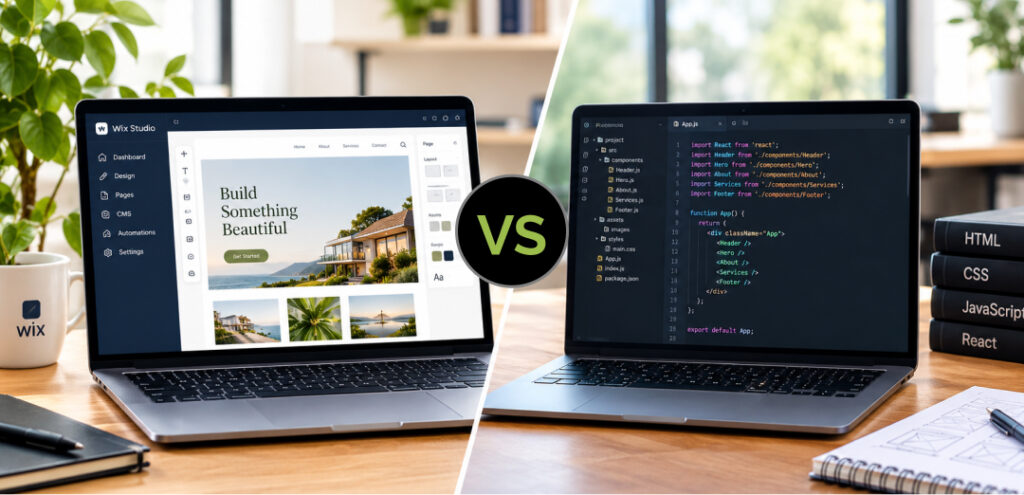
Every business eventually reaches the same crossroads: you need a website, but how should it be built?
On one side is Wix Studio, a professional website-building platform designed to provide flexibility without requiring developers to code everything from scratch. On the other is traditional website development, where developers build a site using code and technologies chosen for the project.
The two approaches can produce very different costs, timelines, and long-term experiences.
Website performance and user experience matter more than ever. Businesses also need to make careful decisions about where their development budgets go. Choosing the wrong approach can waste money and leave a company facing an unnecessary rebuild later.
What Is Wix Studio?
Wix Studio is a professional website creation platform designed for agencies, designers, and businesses. It provides advanced design controls, responsive layouts, reusable components, and collaboration tools without requiring every element to be coded manually.
It sits somewhere between a basic drag-and-drop builder and fully custom development.
That makes Wix Studio appealing to businesses that want considerable website customization while keeping development relatively efficient. However, the platform’s structure also means there are limits to how far customization can go.
What Does Traditional Website Development Involve?
Traditional website development involves building a website using technologies such as HTML, CSS, and JavaScript. Developers may also use a framework or content management system based on the project’s requirements.
Instead of working within a fixed platform, developers have greater control over the site’s code, functionality, and technical architecture.
This approach provides more flexibility, but it usually requires more development time and a larger upfront investment. The final cost depends heavily on the site’s complexity and the number of custom features required.
Development Efficiency: Which Is Faster?
Development efficiency is often one of the first considerations for business owners. A faster launch can help a company start generating value from its website sooner.
Wix Studio generally has an advantage for straightforward business websites. Pre-built sections, design tools, and reusable assets allow experienced designers to build polished pages without developing every component from scratch.
Teams familiar with different development approaches, such as those discussed in our comparison of WordPress vs. custom website development for Memphis businesses, can often identify the right platform before development begins.
Traditional development usually takes longer because more elements must be designed, coded, and tested individually.
However, development speed should not be the only consideration. A website also needs to perform well, remain maintainable, and support the business as it grows.
Website Performance: Speed, Stability, and SEO
Website performance includes factors such as loading speed, mobile responsiveness, stability, and the site’s ability to handle its expected traffic.
Wix Studio runs on Wix’s hosting infrastructure. This means hosting, security, and much of the underlying platform maintenance are handled for you. For many businesses, this simplifies website management.
The tradeoff is control. If a page becomes slow because of complex animations, third-party integrations, or other elements, developers may have fewer options for optimizing the underlying platform than they would with a fully custom site.
Traditional development provides more technical control. Developers can optimize code, images, scripts, and page structures around specific performance goals.
Good design also plays a role in how users perceive a website. Research from the Nielsen Norman Group highlights the importance of design in establishing trust and credibility.
Responsive design matters as well. Both Wix Studio and properly developed custom websites can work across desktop, tablet, and mobile screens. Custom development simply provides more control over exactly how each breakpoint behaves.
Website Customization: How Much Control Do You Need?
Website customization is one of the biggest differences between Wix Studio and traditional development.
Wix Studio provides advanced layout controls, flexible grids, reusable components, and other tools that give designers significant freedom. For many small and mid-sized businesses, these features may be more than enough.
The limitations become more noticeable when a project requires highly specific functionality.
Complex integrations, proprietary systems, unusual customer journeys, or specialized web applications may require capabilities that do not fit naturally within a website builder.
Traditional development offers much greater freedom in these situations. Developers can create custom functionality around the business’s exact requirements.
Businesses considering a custom build can review a website development partner’s previous work to understand what is possible and whether custom development is justified.
Website Maintenance Cost Over Time
Website maintenance cost is another important part of the decision.
Wix Studio combines hosting, platform maintenance, and security updates into its subscription structure. This creates more predictable ongoing costs and reduces the amount of technical maintenance required from the business.
It can also reduce concerns about outdated plugins or software components because the underlying platform is managed by Wix.
Traditional websites can involve more variable costs. Businesses may need to pay separately for hosting, security, maintenance, updates, bug fixes, and developer support.
That does not automatically make custom websites more expensive. A well-built website that requires little maintenance may remain cost-effective for years. However, businesses should account for ongoing technical support when calculating the total cost.
Accessibility should also be part of that maintenance plan. The U.S. Chamber of Commerce’s guidance on accessible website design highlights why accessibility should be considered throughout a website’s lifecycle rather than treated as a one-time task.
So Which Approach Wins?
There is no universal winner.
Wix Studio can be a strong choice for businesses that want a professional website, faster development, and predictable platform management without maintaining a large technical infrastructure.
Traditional website development is usually better suited to businesses with complex functionality, specialized integrations, or long-term plans that require extensive customization.
The decision should start with business requirements rather than technology preferences.
According to Forbes Advisor’s guidance on small-business website design, a successful website should be built around clear business goals and user needs.
For businesses that are still deciding, working with a team that provides both digital marketing and website development expertise can help connect the technical decision to the larger growth strategy.
Choosing the Right Path for Your Growth Plan
The Wix Studio versus traditional development debate ultimately comes down to fit.
A growing business that expects to need complex custom functionality may benefit from traditional development from the beginning. A lean business focused on launching quickly and keeping technical maintenance simple may find Wix Studio more practical.
The important question is not which approach is more advanced. It is which approach gives the business the right balance of performance, customization, cost, and scalability.
Choosing that balance carefully at the start can help businesses avoid unnecessary expenses and costly rebuilds later.