
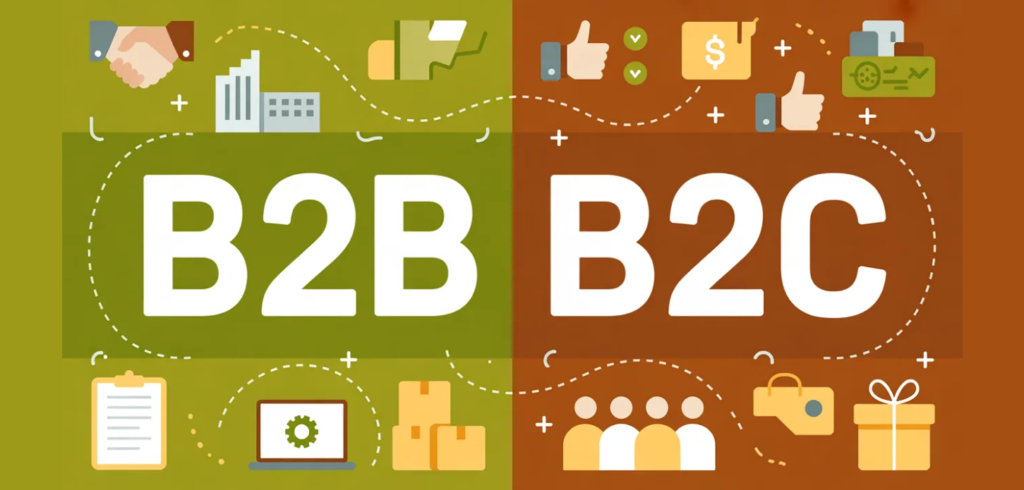
B2B vs B2C content marketing comes down to one question: who are you writing for, and how do they decide to buy? The strategies that win business customers are often very different from the ones that win consumers. Understanding the differences helps you create content that fits the right audience, earns engagement and drives conversions.
In this guide you will see how B2B and B2C content marketing differ in five areas (buyer journey, tone, formats, channels and metrics), plus how to tailor your content for each and what both can learn from the other.
What Is the Core Difference Between B2B and B2C Content Marketing?
Both aim to attract, engage and convert an audience. The main difference is the audience and how they decide.
B2B content marketing
B2B (business-to-business) content targets organizations, decision-makers and professionals. Purchases are strategic, higher in value and often involve several stakeholders. Content focuses on educating, building credibility and proving ROI.
B2C content marketing
B2C (business-to-consumer) content targets individual consumers who usually decide faster and more emotionally. Content is more entertaining and visual, and is built to inspire action such as buying or signing up.
B2B vs B2C Content Marketing at a Glance
| B2B | B2C | |
|---|---|---|
| Audience | Companies, teams, decision-makers | Individual consumers |
| Buying cycle | Long, multiple stakeholders | Short, often emotional |
| Tone | Professional, data-driven | Friendly, relatable, entertaining |
| Top formats | Case studies, whitepapers, webinars, long-form articles | Short video, social posts, infographics, quizzes |
| Main channels | LinkedIn, email, SEO, industry blogs | Instagram, TikTok, Facebook, YouTube |
| Key metrics | Lead quality, pipeline, gated content engagement | Reach, engagement rate, sales, repeat purchases |
1. Buyer Journey and Decision-Making
In B2B, the journey is longer and more complex. Content has to serve awareness, consideration and decision, often for several people at once (an end user, a manager and a finance approver). Case studies, in-depth guides and comparison pages help buyers evaluate options and justify the choice internally.
In B2C content marketing, buyers often decide quickly based on emotion, convenience and trust. Short videos, social posts and infographics grab attention and prompt immediate action.
2. Tone and Messaging
B2B content is typically informative, professional and backed by data. It highlights expertise, industry insight and measurable value.
B2C content is usually friendly, relatable and story-driven. Humor, personality and strong visuals help consumers connect with a brand.
3. Content Formats
B2B formats
- Case studies
- Whitepapers and eBooks
- Long-form blog articles
- Webinars and email newsletters
B2C formats
- Short videos and reels
- Infographics and social media posts
- Interactive quizzes and polls
- User-generated content campaigns
Choosing the right mix is easier with expert help. Our digital marketing services help brands select and optimize formats for each audience.
4. Channels and Distribution
B2B content performs well on LinkedIn, industry blogs and email, and SEO is critical for reaching decision-makers who research solutions online. B2C content thrives on high-traffic social platforms such as Instagram, TikTok and Facebook, where consumers spend a lot of time.
On either side, understanding how platform algorithms decide what gets seen makes a big difference. See our guide to how social media algorithms work.
5. Metrics and KPIs
B2B marketers track lead quality and conversion, engagement with gated content, and partner or influencer interactions. B2C marketers focus on impressions, social shares, engagement rate per post, direct sales and repeat purchases. Different goals mean different scorecards.
How to Tailor Your Content for B2B
- Educate: publish in-depth guides, how-tos and thought leadership.
- Build authority: Publish research-backed insights to establish trust. Forbes Communications Council members explain how quality B2B content marketing builds credibility and drives sales.
- Prove ROI: show measurable results with case studies.
- Support every stage: create content for awareness, consideration and decision.
A strong example is building content pillars that support lead nurturing.
How to Tailor Your Content for B2C
- Engage: entertain, inform or solve a quick problem.
- Tell visual stories: use images, video and interactive content.
- Keep it simple: short, scannable and clear.
- Encourage sharing: make content easy to share and give people a reason to.
B2C content also works best when organic effort is balanced with paid amplification. See our comparison of content marketing vs paid ads.
What B2B and B2C Content Marketing Have in Common
In the B2B and B2C debate, some rules apply to both:
- Consistency: a regular publishing schedule keeps audiences engaged.
- Audience insight: analytics show what people actually respond to.
- SEO: optimized content is easier to find in both models.
- Visual quality: good design improves performance everywhere. Our graphic design services help with that.
Businesses that sell locally can go a step further by combining content with local search.
Which Approach Is Right for You?
- You sell to companies: lead with B2B content such as case studies, guides and webinars, and focus on LinkedIn, email and SEO.
- You sell to consumers: lead with B2C content such as short video, social and visual storytelling.
- You sell to both (for example an ecommerce brand with a wholesale arm): run two content tracks with different tone, formats and metrics, but one shared brand voice.
FAQ
What is the main difference between B2B and B2C content marketing?
B2B targets organizations with longer, research-heavy decisions, so content educates and proves ROI. B2C targets individuals who decide faster, so content is more emotional and visual.
Is B2B content marketing harder than B2C?
Not necessarily harder, but slower. B2B sales cycles are longer and involve more people, so content has to support several stages and stakeholders.
Which platforms work best for B2B and B2C?
LinkedIn, email and SEO tend to lead for B2B. Instagram, TikTok, Facebook and YouTube tend to lead for B2C. Test with your own audience.
Can one content strategy work for both?
You can share a brand voice and values, but tone, formats, channels and metrics usually need to differ.
Need a Content Plan?
A well-rounded content strategy brings together digital marketing, design and SEO. Talk to a Memphis digital marketing agency about a plan for your audience.