Artificial Intelligence (AI) has transitioned from a futuristic concept to a critical component of modern business strategy. Companies across industries are leveraging AI to improve operational efficiency, enhance customer experiences, and gain a competitive edge. Implementing AI without a clear strategy can lead to wasted resources and failed projects.
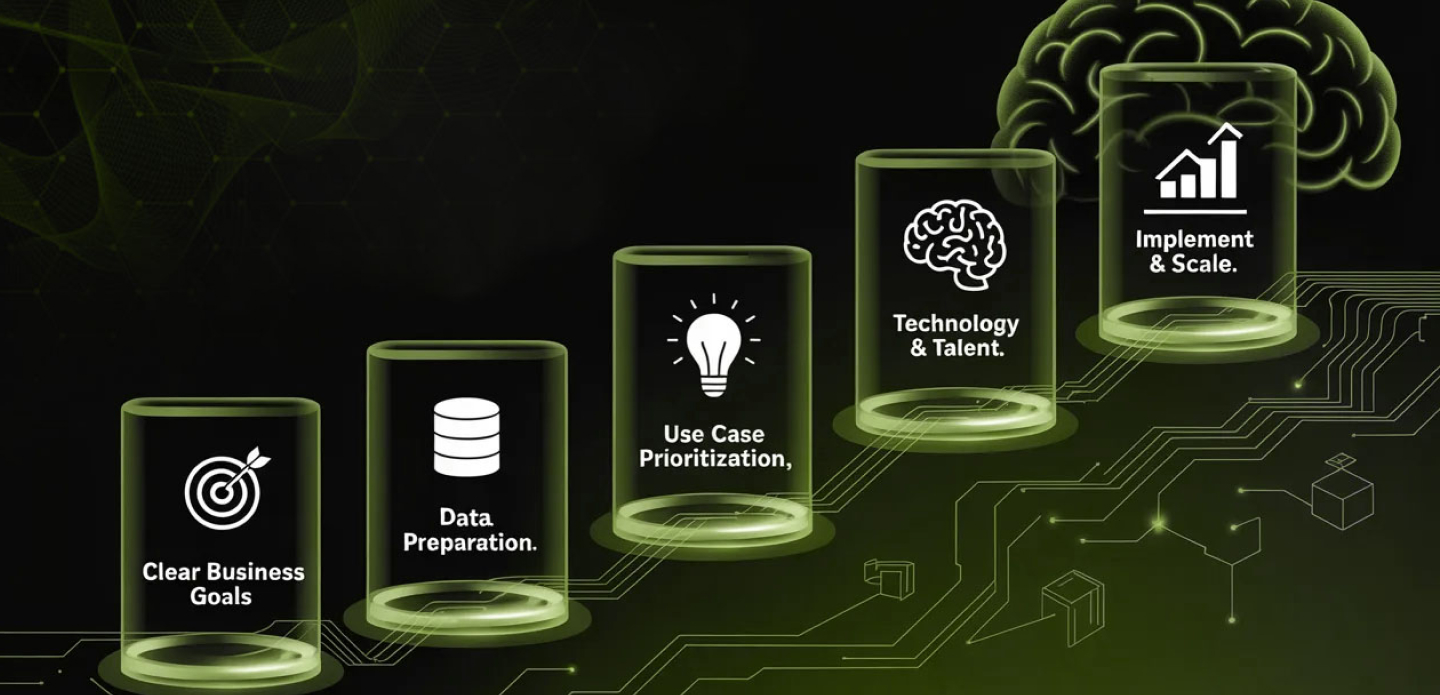
A robust AI strategy ensures that AI initiatives are aligned with business goals, have measurable outcomes, and can be scaled effectively. Businesses often begin with AI Strategy & Consulting to ensure proper alignment between technology investments and long-term objectives. In this article, we explore a structured 5-step framework to guide businesses from identifying opportunities to building a roadmap and measuring success.
Step 1: Identify and Prioritize Opportunities
The first step in any successful AI strategy is identifying where AI can deliver real business value.
a) Align AI with business goals
AI initiatives must support the organization’s core objectives. Focus on areas that can impact revenue, reduce costs, or enhance customer experiences.
Questions to ask include:
Which business processes are inefficient or error-prone?
Where can automation or AI-driven insights make a difference?
What unique advantages can AI provide over competitors?
b) Brainstorm potential use cases
Generate a list of AI use cases relevant to business domains such as marketing, operations, customer service, or supply chain management. Evaluate each idea based on impact and feasibility.
Prioritize use cases that provide high impact and are technically feasible. Quick wins help demonstrate AI value early and build organizational support.
Deloitte: Building an Effective AI Strategy.
Step 2: Assess Readiness and Build Foundations
Before implementing AI, ensure the organization has the proper infrastructure, skills, and governance.
a) Data readiness
AI systems rely heavily on quality data, as machine learning models depend on accurate and well-structured datasets, according to Wikipedia’s definition of Machine Learning. Conduct a thorough audit of data sources, evaluating completeness, accuracy, and accessibility. Identify data silos and establish processes to maintain high-quality datasets.
b) Infrastructure, tools, and talent
Evaluate whether your current infrastructure supports AI workloads. Consider cloud services, storage, processing power, and integration capabilities. Decide whether to use existing platforms or invest in new tools.
Organizations developing scalable AI solutions often rely on AI-Powered Software Engineering to ensure models are built, tested, and deployed efficiently.
A successful AI strategy requires a combination of data scientists, ML engineers, domain experts, product managers, and business stakeholders. Form cross-functional teams to ensure alignment with business objectives, as outlined in IBM’s guide to building an effective AI strategy.
c) Governance and organizational readiness
Implement AI governance frameworks to address fairness, transparency, accountability, and regulatory compliance. Train staff, create awareness, and foster collaboration between human and machine decision-making.
Step 3: Build a Roadmap and Pilot Strategy
Develop a structured plan for AI deployment.
Pilot Phase: Test AI in a small scope to validate feasibility and value
Expansion Phase: Roll out AI solutions to multiple business units
Enterprise AI Phase: Scale solutions organization-wide with continuous optimization
Select whether to build AI solutions in-house or collaborate with vendors. Define success criteria for each AI initiative, including technical KPIs, operational metrics, and business outcomes.
Step 4: Execute, Monitor, and Iterate
AI deployment requires continuous monitoring and refinement.
Model development and deployment: Follow best practices such as version control, automated pipelines, and testing
Integration with workflows: Integrate AI solutions into systems, dashboards, and decision-making processes
Continuous monitoring: Track model performance, detect drift, and monitor reliability
Iterative improvement: Retrain and refine AI models based on new data and feedback
Seamless AI Integration & Automation ensures AI systems connect effectively with existing business tools and operational workflows.
Step 5: Measure, Analyze, and Scale
Measuring results ensures AI initiatives create tangible business value.
Define KPIs: Include technical, operational, and business-impact metrics
Compare baseline and post-implementation metrics: Quantify improvements and ROI
Optimize and scale: Expand initiatives that demonstrate value, adjust underperforming ones, and incorporate lessons learned into the AI roadmap
Conclusion
A successful AI strategy involves aligning initiatives with business objectives, ensuring readiness, executing thoughtfully, and measuring outcomes. By following this 5-step framework, identifying opportunities, assessing readiness, building a roadmap, executing and iterating, and measuring impact, organizations can unlock the full potential of AI and drive sustainable business value.