
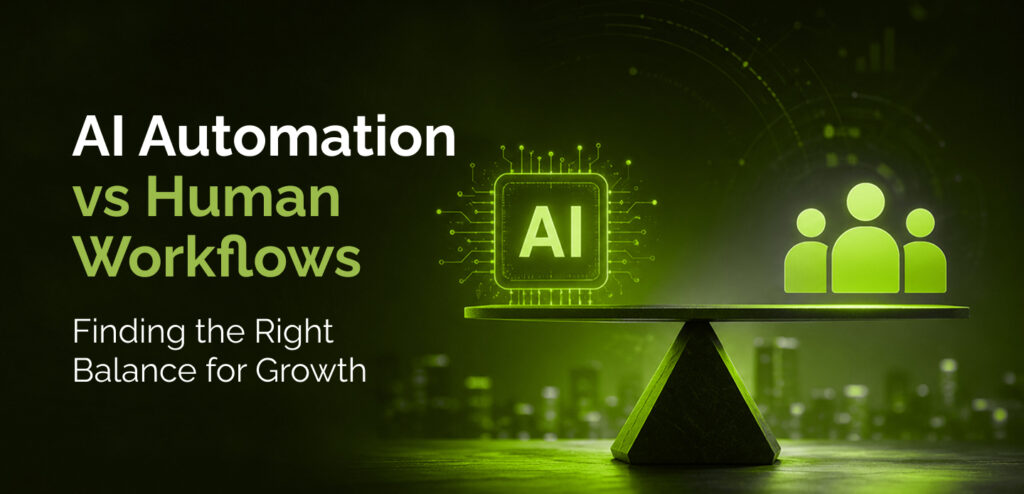
The conversation around ai automation often creates the impression that businesses must choose between technology and people. In reality, the most successful organizations understand that growth comes from combining both. Rather than replacing employees entirely, AI is increasingly being used to enhance decision-making, streamline repetitive work, and improve operational efficiency.
As businesses seek ways to scale, reduce costs, and improve customer experiences, finding the right balance between automation and human expertise has become a strategic priority. The challenge is not deciding whether to automate, but determining which processes benefit from automation and which require human judgment.
By understanding the strengths of both approaches, organizations can create more effective automation workflows, strengthen business operations, and achieve sustainable growth.
Understanding AI Automation in Modern Business
At its core, ai automation refers to the use of artificial intelligence technologies to perform tasks, analyze data, and execute processes with minimal human intervention.
According to insights from Wikipedia, automation involves operating systems and processes with reduced human assistance. Modern AI-powered automation extends this concept by incorporating machine learning, predictive analytics, and intelligent decision-making capabilities.
Today, organizations use AI for customer service, data processing, content generation, workflow management, and operational optimization. These technologies continue to evolve, enabling businesses to automate increasingly complex activities.
The goal is not simply reducing manual effort. It is improving efficiency, accuracy, and scalability across the organization.
Where AI Automation Delivers the Greatest Value
Certain business functions are particularly well suited for automation.
- Repetitive administrative tasks
- Data entry and processing
- Customer support routing
- Workflow approvals
- Inventory management
- Reporting and analytics
These applications help organizations reduce manual workloads while improving consistency and operational efficiency.
Businesses investing in AI Integration & Automation often discover that automation enables teams to focus on higher-value activities rather than routine tasks. This shift contributes to stronger productivity and more efficient resource allocation.
The value of task automation becomes even more apparent as organizations scale and operational complexity increases.
The Human Advantage That Technology Cannot Replace
Despite impressive technological advancements, human expertise remains essential in many areas of business.
Strategic thinking, creativity, empathy, ethical judgment, and relationship-building continue to rely heavily on human capabilities. While AI can analyze large datasets and generate recommendations, people remain responsible for interpreting insights and making critical decisions.
Customer relationships provide a strong example. Automated systems can answer routine questions, but complex situations often require emotional intelligence and nuanced communication.
Similarly, innovation frequently emerges from human creativity and collaboration rather than purely algorithmic processes.
Organizations that rely too heavily on automation risk creating experiences that feel impersonal or disconnected from customer needs.
Why Businesses Need a Balanced Approach
The most effective growth strategies combine automation with human oversight.
Rather than viewing technology as a replacement for employees, leading organizations use AI to augment human capabilities. This approach creates a more efficient operating model while preserving the qualities that make businesses competitive.
Research published by McKinsey & Company suggests that generative AI has the potential to significantly increase productivity across industries. However, realizing that value requires thoughtful implementation and organizational adaptation.
A balanced strategy allows businesses to improve efficiency without sacrificing quality, innovation, or customer experience.
Signs a Process Should Be Automated
Identifying suitable automation opportunities is critical for maximizing return on investment.
- The task follows predictable rules
- Large amounts of data require processing
- Human error frequently occurs
- The process is repetitive and time-consuming
- High transaction volumes create bottlenecks
- Scalability is difficult with manual execution
When these characteristics are present, process automation often delivers measurable improvements in efficiency and performance.
Organizations implementing Digital Workers frequently use them to manage repetitive operational activities while allowing employees to focus on strategic priorities.
This combination improves both productivity and employee satisfaction by reducing low-value manual work.
Workflow Optimization Requires More Than Automation
A common misconception is that technology alone solves operational inefficiencies.
In reality, poor processes remain inefficient even when automated. Before implementing AI solutions, organizations should evaluate existing workflows to identify bottlenecks, redundancies, and unnecessary complexity.
Effective workflow optimization begins with understanding how work currently flows through the organization. Once inefficiencies are identified, automation can be applied strategically to improve outcomes.
Businesses that automate flawed processes often accelerate problems rather than solving them.
Successful implementation requires process redesign alongside technology adoption.
The Role of Productivity Tools in Future Workplaces
The future workplace will increasingly combine human expertise with intelligent systems.
Modern productivity tools help employees manage information, automate repetitive activities, and access insights more quickly. Rather than replacing workers, these technologies act as digital assistants that enhance performance.
Recent research available through arXiv highlights the growing impact of large language models and AI systems across professional workflows. These technologies are reshaping how knowledge work is performed while creating new opportunities for efficiency and innovation.
Organizations that embrace collaborative human-AI models are often better positioned to adapt to evolving market conditions.
Learning from Real-World Automation Success
Successful automation initiatives typically begin with targeted use cases rather than organization-wide transformation.
Many businesses start by automating repetitive administrative tasks before expanding into customer service, analytics, or operational management. This gradual approach allows teams to build confidence while minimizing disruption.
For example, this guide on Workflow Automation for Efficiency and Cost Reduction explores practical strategies for implementing automation in ways that improve productivity and support long-term growth.
Organizations that prioritize measurable outcomes often achieve greater success than those pursuing automation purely for technological reasons.
Building a Sustainable Growth Strategy
Long-term success requires balancing efficiency with adaptability.
Businesses should view automation as a strategic enabler rather than an end goal. The objective is not to eliminate human involvement but to ensure people focus on tasks where they create the greatest value.
When AI handles repetitive work and employees focus on creativity, relationship-building, and strategic thinking, organizations benefit from the strengths of both.
This balance supports stronger decision-making, improved customer experiences, and more resilient operations.
Conclusion
The debate between ai automation and human workflows is not about choosing one over the other. Sustainable growth comes from integrating both effectively.
Automation excels at handling repetitive, data-driven activities, while humans provide creativity, empathy, and strategic insight. Together, they create a powerful foundation for modern business success.
Organizations that thoughtfully implement automation workflows, leverage productivity tools, and continuously improve business operations will be better equipped to adapt, innovate, and grow in an increasingly competitive environment.
The future belongs to businesses that understand how technology and people can work together, not those that attempt to replace one with the other.