
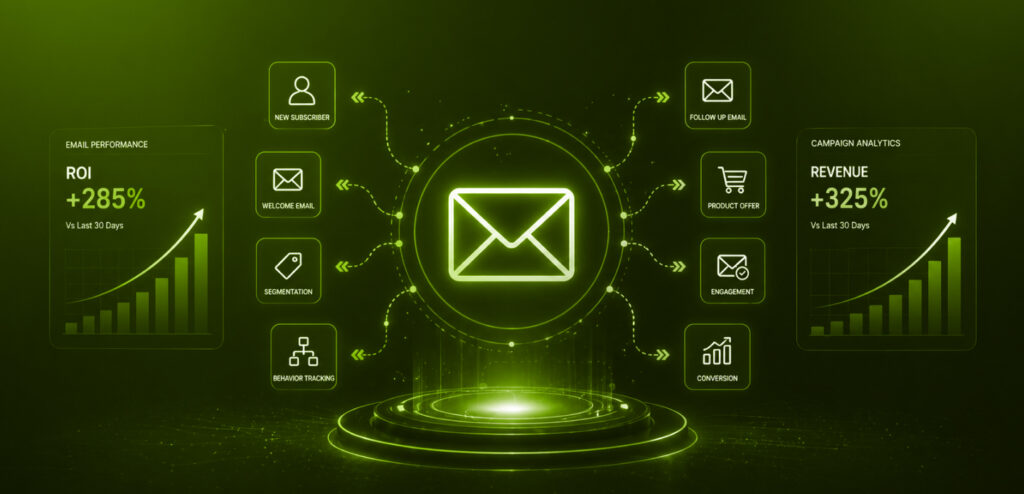
Email marketing automation remains one of the most powerful tools for driving consistent revenue and customer engagement. While many businesses use email as a basic communication channel, those who leverage automation strategically see significantly higher returns.
At its core, Email Marketing Automation is about delivering the right message to the right person at the right time without manual effort. It allows businesses to nurture leads, build relationships, and convert prospects into customers through personalized, data-driven workflows.
Why Email Marketing Automation Delivers High ROI
Email marketing continues to outperform almost every other digital marketing channel in terms of return on investment. Studies show that businesses earn approximately $36–$42 for every $1 spent on email marketing, making it one of the most cost-effective strategies available
This exceptional ROI is driven by automation, personalization, and scalability. Automated workflows allow businesses to generate consistent results without increasing manual workload. In fact, automated email flows can generate a significant portion of total email revenue despite representing a small percentage of total sends
Understanding return on investment (ROI) is essential for evaluating performance.
What Makes Email Automation Truly Effective
Many businesses set up basic automation sequences but fail to optimize them for performance. True success comes from advanced strategies that focus on user behavior, segmentation, and continuous optimization.
Email automation is not just about sending emails. It is about creating a system that adapts to user actions and delivers relevant content at every stage of the customer journey.
High-performing automation systems typically focus on:
- Behavioral triggers based on user actions
- Personalization using customer data
- Continuous testing and optimization
These elements ensure that your campaigns remain relevant and effective over time.
Advanced Strategy 1: Behavioral Segmentation for Precision Targeting
One of the most effective ways to increase ROI is through segmentation. Instead of sending generic emails to your entire list, segmentation allows you to target users based on their behavior, preferences, and engagement levels.
Segmented campaigns generate significantly higher engagement and revenue compared to generic campaigns. In fact, data shows that segmentation can dramatically increase revenue and performance
For example, you can segment users based on:
- Purchase history
- Website activity
- Email engagement levels
This approach ensures that each subscriber receives content that is relevant to their needs, increasing the likelihood of conversion.
Advanced Strategy 2: Email Open Rate Optimization Strategies
Improving open rates is essential for maximizing the impact of your campaigns. Even the best email content will not perform if it is never opened.
Effective email open rate optimization strategies focus on creating compelling subject lines, optimizing send times, and maintaining a clean email list.
Some proven approaches include:
- Writing concise and curiosity-driven subject lines
- Personalizing subject lines with user data
- Testing different send times based on audience behavior
Consistency also plays a key role. Regular communication helps build familiarity and trust, making subscribers more likely to open future emails.
Advanced Strategy 3: Lifecycle Automation for Continuous Engagement
Lifecycle automation focuses on guiding users through every stage of their journey, from initial awareness to post-purchase engagement.
Instead of relying on one-off campaigns, businesses should create automated sequences that nurture relationships over time. These sequences can include welcome emails, onboarding flows, and re-engagement campaigns.
Lifecycle automation helps businesses:
- Build stronger customer relationships
- Increase repeat purchases
- Improve long-term customer value
By maintaining consistent communication, businesses can stay top-of-mind and drive ongoing engagement.
Advanced Strategy 4: Personalization Beyond First Names
Basic personalization, such as including a user’s name, is no longer enough. Advanced personalization involves using data to tailor content, recommendations, and offers to individual users.
AI-driven personalization has been shown to significantly improve engagement and revenue. Businesses that use advanced personalization strategies often see higher click-through rates and conversions
Personalization can include:
- Product recommendations based on browsing behavior
- Dynamic content tailored to user preferences
- Location-based offers and messaging
This level of personalization creates a more relevant and engaging experience for users.
Advanced Strategy 5: Automation for Revenue-Driven Campaigns
Not all automated emails are created equal. Some workflows consistently outperform others in terms of revenue generation.
High-performing automated campaigns include:
- Abandoned cart emails
- Welcome sequences
- Post-purchase follow-ups
These campaigns target users at critical moments in their journey, making them highly effective for driving conversions. Research shows that automated workflows can generate significantly higher returns compared to standard campaigns
Aligning Automation With Your Marketing Strategy
Email marketing automation should not operate in isolation. It needs to be integrated with your overall marketing strategy to maximize results.
For example, aligning email campaigns with digital marketing’s broader strategies ensures consistency across channels and improves overall performance.
When email automation works alongside content marketing, social media, and paid campaigns, it creates a unified experience that strengthens your brand and drives conversions.
Using Data to Continuously Improve ROI
One of the biggest advantages of email marketing automation is the ability to track and measure performance. Data provides insights into what is working and where improvements are needed.
Key metrics to monitor include:
- Open rates and click-through rates
- Conversion rates and revenue per email
- Subscriber engagement and retention
By analyzing these metrics, businesses can refine their strategies and improve performance over time.
For deeper insights into conversion optimization, this guide on What is CRO? A Beginner’s Guide to Conversion Rate Optimization is highly relevant.
Leveraging AI in Email Marketing Automation
AI is playing an increasingly important role in email marketing automation. It enables businesses to analyze large datasets, predict user behavior, and deliver more personalized experiences.
AI-powered automation can:
- Predict the best time to send emails
- Recommend content based on user behavior
- Optimize subject lines and messaging
This level of intelligence allows businesses to scale their efforts while maintaining high levels of personalization and engagement.
Common Mistakes That Reduce ROI
Despite its potential, many businesses fail to achieve high ROI from email marketing automation due to avoidable mistakes.
Some of the most common issues include:
- Sending too many emails without clear value
- Ignoring segmentation and personalization
- Failing to test and optimize campaigns
- Poor email deliverability and list management
Avoiding these mistakes is essential for maximizing the effectiveness of your automation strategy.
Building a Scalable Email Automation System
To achieve long-term success, businesses need to build scalable systems that can grow with their needs. This involves creating flexible workflows, integrating tools, and continuously improving processes.
Automation should be designed to handle increasing volumes of data and interactions without compromising performance.
For businesses looking to scale their marketing efforts, Digital Transformation Services provides solutions that align technology, strategy, and execution for sustainable growth.
Conclusion
Email marketing automation is one of the most powerful tools for driving consistent revenue and improving marketing efficiency. With the right strategies, businesses can create personalized, data-driven campaigns that deliver measurable results.
From segmentation and personalization to lifecycle automation and AI integration, the key to success lies in continuous optimization. Businesses that invest in advanced strategies will not only improve their ROI but also build stronger relationships with their audience.