How to grow an e-commerce business? All future e-commerce entrepreneurs hope to reach a point when orders arrive in large quantities, carts fill up, and income begins to rise. However, the bad news is that in many cases, starting an e-commerce business is the easy part of the business. Expanding profitably is where the majority of brands fail.
This is not due to the lack of demand, as the global e-commerce sales are expected to keep growing at a brisk pace. However, even as demand for ecommerce rises, it is only a small number of brands that make it through the initial momentum and into long-term sustainable development.
Scaling an e-commerce business is harder than starting one
It all comes to a very bitter reality that e-commerce growth strategies on paper do not necessarily translate into growth in the bank.
Most founders are interested in finding customers and increasing income without developing the systems. Systems that will enable more orders and greater margins.
With more order counts, costs such as logistics, customer service, etc., tend to increase at an equal or even greater rate than revenue. Scaling can be used efficiently to grow revenue without growing the expenses; This demands strategic planning, automation, and financial discipline.
Profitable Sales Funnel Optimization
Provided that developing an e-commerce company was just opening up the ads and waiting to see the sales increase, every brand with a credit card and a Shopify would become one of the category leaders. However, it is not just a question of getting traffic, but getting the right traffic, which is one that actually converts.
Why Traffic Quality is More Important than Traffic Volume?
Think about this: after an average breakthrough in e-commerce, the standard conversion rates throughout the world range between 2%-3%, which is based on the industry and platform.
It implies that 97%-98% of visitors do not make a purchase. It is pointless to drive a lot of traffic without conversion, since it is like filling a leaky bucket; you are throwing your resources in without any significant outcome.
Then the actual question of central interest is:
What can the brands do to attract visitors who have a higher chance of becoming paying clients?
Solution: By streamlining all stages of the sales funnel, being more quality-driven to engage and offer a buyer-oriented experience.
Inviting the Right Visitors
The volume should not be used to measure the relevance in paid campaigns and organic traffic. One thousand dollars per week to advertise widely may bring in clicks, not, perhaps, profit-making orders.
A brand refining its targeting, with interest, behaviour, and intent in mind, tends to have a lower CAC and a greater conversion. Sound e-commerce growth strategies are based on getting targeted traffic.
Conversion Rate Optimization (CRO): Making Clicks Customers
The traffic will not be converted by even the best traffic unless it has a friction-free experience. The following are three effective CRO pillars that can always shift the needle:
Optimized Product Pages
Good quality photos, obvious advantages, testimonies, and straightforward text make curious visitors become sure purchasers.
Streamlined Checkout Flows
The average abandonment rates are approximately 70%. A very high percentage of consumers abandon their carts because there are too many forms to complete, an unpleasant surprise in shipping, or because the page is too tricky. Reducing the number of clicks during the checkout process to one page, clear price tags can allow for an increase in the number of conversions substantially.
Trust Signals & Social Proof
Reviews, verified badge, and secure checkout logos, as well as actual customer testimonial,s lessen the anxiety of the buyer, particularly the first-time visitor.
Beyond the First Sale: Lifetime Value
One of the most profitable scaling aspects that most brands fail to consider is Customer Lifetime Value (LTV), which is the amount of revenue a customer can bring in the long term.
It is costly to attract new customers:
- Mean CAC in e-commerce has been increasing with the competition.
- Paid channels compel the brands to part with more money in order to stay on the radar.
However, as you well know, you can increase LTV by:
- Automation of emails and segmented emails.
- Loyalty programs or subscription programs.
- Check out upselling and cross-selling.
…you do not only recoup the cost of acquisition more through revenues – you also boost profitability.
But what happens when you dismiss Unit Economics?
This is the risk: The profitability can decrease, and revenue can increase. Most businesses ramp sales on the top line using aggressive advertisements, only to find out that they are losing money on each additional sale since no one ever analyzed the contribution margins.
So the key question becomes:
Are your marketing results in line with your actual product margins and business economics?
When the response is I do not know, you are not alone, and that is where strategic financial management must be employed.
Scaling Cash Flow and Margins
Income does not necessarily imply additional funds. It is the point that most founders fail at in the beginning:
A flood of orders is very attractive on a dashboard…
…but covering suppliers, warehouses, advertisements, shipping, returns, and employee bills is a rapid drain on the wallet.
It is the main question every e-commerce company should answer as it grows:
What do you do to make sure growth does not cause cash flow pressure?
The solution is in controlling working capital, margins, and the real movement of cash, not only revenue.
Inventory Planning: The Equilibrium Game
The inventory is the blood of an online store, yet it could turn out to be its greatest cash sink. Excessive stock occupies working capital. An inventory that is too small results in missed sales and dissatisfied customers.
Expert brands:
- Predict demand based on trends in data.
- Time buys to sustain the turnover.
- Eliminate the risk of overstocking that eats away at cash reserves.
This form of planning has a direct influence on profitability and the health of the cash flow.
Real Profitability and Contribution Margins
Revenue in itself is not so valuable without knowing the portion of that revenue that could be considered as actual profit after costs. The effects of every product sold include:
- Shipping fees
- Payment processing charges
- Advertising costs
- Fulfillment costs and returns
Followingthe contribution margin, profit after variable costs will inform you whether it is possible to scale a product or campaign, or if it is a liability.
Professional Support Where it Counts
Data discipline is needed in the management of the mechanics of cash. That is why numerous developing brands resort to an e-commerce accounting service to be able to keep actual performance monitoring, working capital management, and identify possible bottlenecks before they turn into crises.
Proper reporting enables the business organizations to identify key performance indicators that actually do matter:
- Gross Margin
- CAC vs. LTV
- Burn Rate
And as soon as books are clean and reconciled within the sales channels, such as Shopify, Amazon, and marketplaces, decisions are quicker, smarter, and much more profitable.
To this clarity is added reliable accounting and bookkeeping services, which would support:
- Clean financial records
- Sales reconciliation in multi-channel.
- Scalability workflows automation.
- KPI dashboards that include actionable insights.
How To Grow An E-Commerce Business?
You are aware now of two fundamental facts about scaling:
- An efficient, high-performing sales funnel
- Good cash flow that keeps operations intact.
When the foundations are established, several e-commerce enterprises reach a new point of intersection: “How do I go beyond basic strategies and actually kick-start growth without losing its profitability?
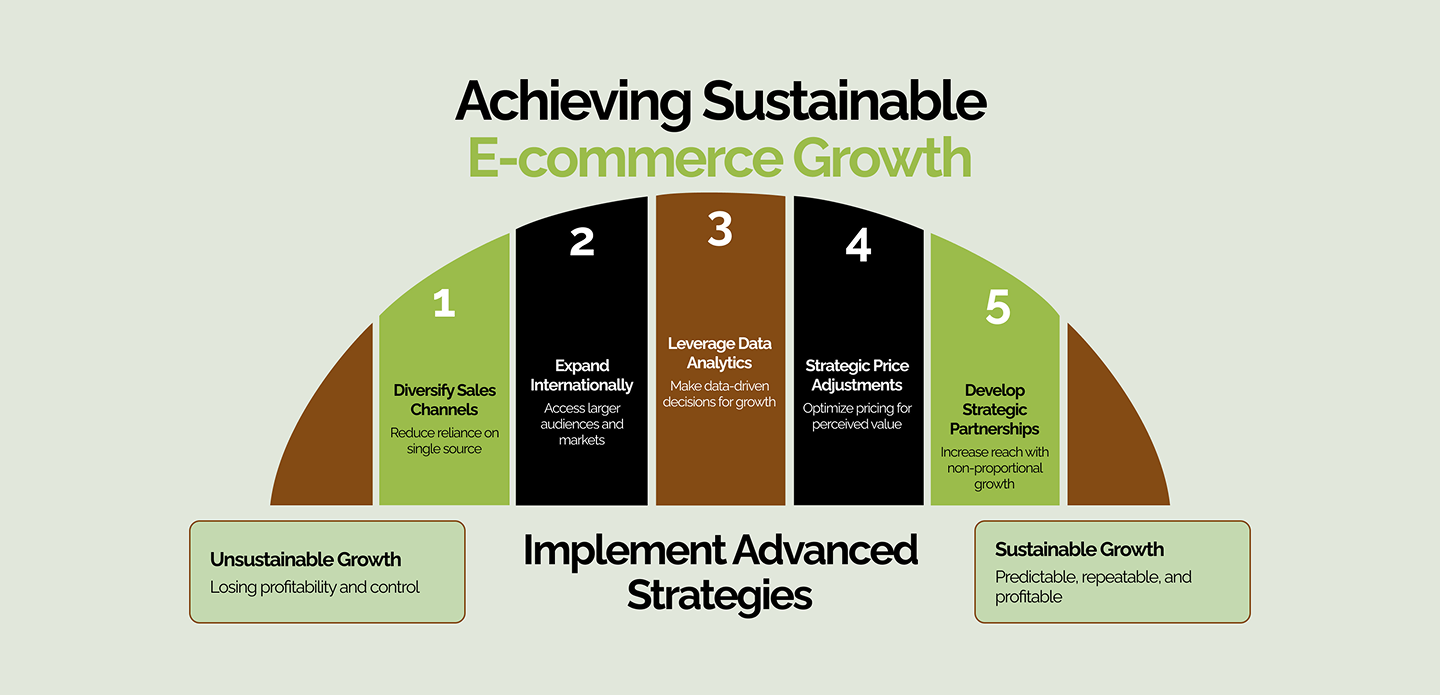
This is where complex e-commerce growth strategies are applied – and where decision-making based on data sets the difference between long-term success and expensive mistakes.
Are You Able to Scale Higher without Losing Control?
The simple response is yes, but only when there is discipline in applying the right strategies.
Automatic “doing more” means doing more advertisements, more products, more inventory, etc., which is seldom an efficient, long-lasting growth. The industry research indicates that scaling too fast without strategic underpinning may decrease profit margins and result in a cash-flow strain, particularly in competitive verticals, such as fashion, electronics, and direct-to-consumer (D2C) brands.
So the key question becomes:
What are the advanced strategies that really make profitable scaling- and what are the pitfalls that should be avoided at any rate?
Let’s explore both.
Categories of Sales Channels
It is dangerous to depend on a single source of revenue – especially when this source can alter algorithms, policies, or fees overnight.
Diversification of the channels through marketplaces (Amazon, Walmart Marketplace), social commerce (Instagram, TikTok Shopping), and storefronts internationally lessens the reliance on a single channel.
The studies indicate that the omnichannel retailers produce up to 200 percent higher sales than the single-channel stores.
Diversification does not simply require visibility, but it involves risk mitigation and reaching customers where they already like to shop.
Expanding Internationally
Expansion into other international markets is among the most effective methods to open new demand – yet it is one of the most complicated.
Pros:
- Access to larger audiences
- Greater average order statistics in high-quality markets.
- Hemispherical balance of seasons.
Cons:
- Local levels of compliance and tax.
- Customer service requirements are multilingual.
- International logistics issues.
The successful brands running in the international market through data, optimal local payment, and logistics partners make sure the growth in profits is not only in terms of revenue but also in profitability.
Leveraging Data Analytics
It is like flying without information. The top performing brands also apply analytics to answer such questions as:
- Which are the most lucrative channels in terms of lifetime value customers?
- What are the products with the highest contribution margins?
- Which campaigns are cost-effective in terms of profits?
As an example, the tracking of cohort retention rates and repeat purchase behavior would enable the brands to distribute the budget to the campaigns that generate long-term profit rather than short-term clicks.
Strategic Price Adjustments
Even minor price changes are capable of creating a disproportionately large effect.
Advanced pricing algorithms demand-driven, inventory-driven, competitor-driven: by changing margins (but not conversion) by 1-5% and more.
But it is not all about math in pricing; it is about psychology. Tiered pricing, bundle pricing, and value-based pricing have an impact on perceived value and purchase behaviors.
Developing Strategic Partnerships
Partnerships with complementary brands and influencers, or fulfillment partners, can increase reach with non-proportional growth in advertising investment.
Co-marketing campaigns and affiliate relationships are based on the audiences of other people, which is frequently more cost-effective than paid acquisitions.
Top 5 Growth Killers
The most appropriate strategies cannot work without proper implementation and money discipline. These are the traps that slow-moving brands have constantly fallen into:
Scaling Ads Without Cash Flow Tracking
Huge expenditure will result in increased orders; however, as soon as one buys customers at a higher price than customers are worth without lifetime value, the profitability would be devastated.
Ignoring Operational Costs
Warehousing, returns, wrapping, and customer service are all very expensive. You may believe that growth is profitable when it is, in fact, taking away margins without following them.
Poor Inventory Management
Excessive inventory is a waste of money; inadequate inventory is a waste of revenue. This balancing is very important, especially during peak seasons.
Increasing Revenue And Decreasing Margins
Revenue growth will appear fabulous on dashboards, whereas declining margin is a silent killer. When the top line is given more attention without unit economics, it results in unsustainable scaling.
Absence of Structured Financial Forecasting.
Forecasting is not optional. Effective forecasting brands are able to predict cash requirements, make predictions on seasonality, and prevent surprises.
The Real Secret of Sustainable Growth?
Discipline is needed in sustainable scaling. It pertains not only to strategies but also to data, transparency, and long-term economic vision.
You can not grow out of problems you do not know.
Conclusion: Sustainable Growth Is Strategic
Suppose you are serious about learning how to grow an e-commerce business, then the underlying insight is:
E-commerce growth strategies are not only about traffic or sales, but it is also the intelligent balancing of the marketing, operations, and financial systems.
- Unoptimized traffic is a waste of money.
- Unmanaged cash-flow revenue results in unsustainable burn.
- Growth based on a lack of financial discipline causes stagnation.
But when you combine:
- strong conversion funnels, scrupulous cash flow management.
- scalable financial operations.
…growth becomes predictable and begins to be repeatable and profitable.
To answer the question: how to grow an e-commerce business?
The real success does not lie with the brands that have the largest advertisements, but rather with the ones that can present more effective data, wiser choices, and have a more financial background.
Strategies that combine sound strategy with formal financial management create not only larger companies, but healthier and more sustainable companies that are in every marketplace.