
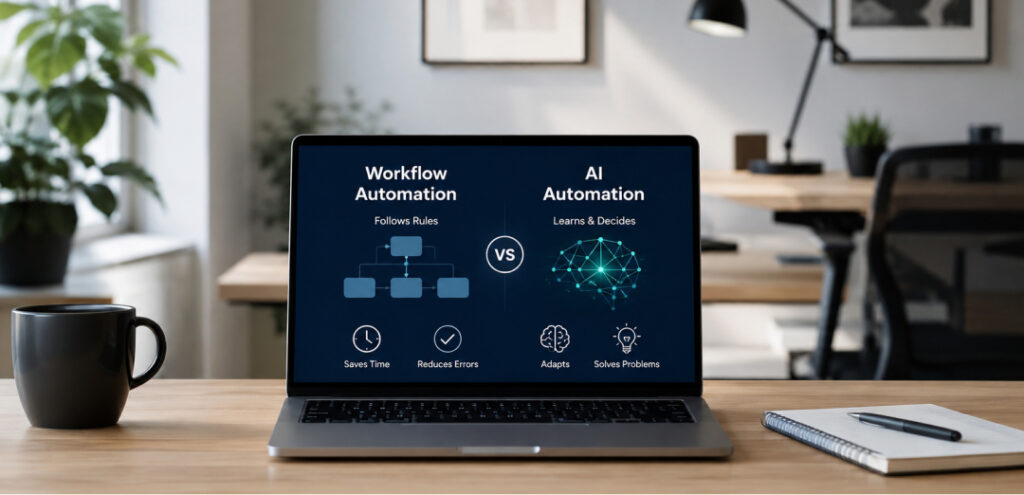
Business leaders hear these terms used interchangeably almost every day, and it causes real confusion. Someone recommends workflow automation to fix a bottleneck, another person suggests AI automation for the same problem, and suddenly a simple decision feels complicated. The two approaches solve different kinds of problems, and understanding that difference matters before a business invests time or budget into either one.
This guide breaks down what separates the two, where they overlap, and how a growing business can decide which approach fits a given process.
What Is Workflow Automation?
Workflow automation uses predefined rules to move tasks through a fixed sequence without manual intervention. A trigger happens, and the system follows a set path every time. Think of an invoice that gets routed to a manager for approval, or a new lead that gets automatically added to a CRM and assigned to a sales rep.
The logic behind workflow automation is straightforward. If a condition is met, a specific action follows. There is no interpretation involved. That predictability is exactly what makes it reliable for repetitive, rule-based work.
For a deeper walkthrough of how this works in practice, thisworkflow automation guide covers the fundamentals of mapping a process before automating it, along with common use cases across departments like HR, finance, and customer support.
What Is AI Automation?
AI automation is a different animal entirely. Instead of following a fixed rule for every situation, it uses machine learning and pattern recognition to make judgment calls, adapt to new data, and handle tasks that do not follow a single predictable path.
A basic workflow automation tool typically follows predefined rules when handling an email. An AI system can go further by interpreting the message and assessing what should happen next. An AI system can, because it learns from patterns rather than sticking rigidly to a script.
This is also where the conversation gets more nuanced. Research from Harvard Business School points out that not every task should be fully automated. Some work benefits more from AI augmenting human judgment rather than replacing it entirely, which raises a real strategic question for any leader deciding how far to take automation in a given process.
Key Differences Between Workflow Automation and AI Automation
The clearest way to separate the two is by how much judgment is involved.
Workflow automation handles tasks that are repetitive and rule-based, where the outcome is the same every time a condition is triggered. AI automation handles tasks that involve variability, where the system needs to interpret information before deciding what to do next.
Workflow automation is also generally easier and faster to set up. Most tools work with simple if-this-then-that logic. AI automation usually requires more data, more testing, and ongoing tuning to perform well, since the system is learning rather than just following instructions.
Neither approach is inherently better. They solve different problems, and many businesses end up using both side by side.
How Business Process Automation Fits Into the Picture
Business process automation is the broader umbrella that both workflow automation and AI automation fall under. It refers to the overall practice of using technology to reduce manual work across an organization, regardless of whether the underlying system relies on fixed rules or adaptive intelligence.
Business process optimization goes one step further. Rather than automating a process as it currently exists, optimization asks whether the process itself needs to change first. A poorly designed process that gets automated is still a poorly designed process, just executed faster. This is why businesses should map and evaluate a workflow before automating it. Good process design is just as important as the automation itself.
Where AI Automation Adds the Most Complexity and Value
AI’s impact on business work is not evenly distributed. Research published by MIT Sloan Management Review describes three stages of AI-driven automation. AI can first assist a task, then reshape how it gets done, and eventually replace it. That progress happens unevenly across roles and industries, since factors like judgment, regulation, and error tolerance can speed it up or slow it down depending on the task.
This uneven progress is exactly why a rushed AI rollout often underdelivers. A task that seems ready for full automation might actually still need human oversight, while another task that looks complex could already be a strong candidate for AI to handle independently.
Newer academic research digs into how this plays out at a structural level. A recent study on how AI reshapes work examines how firms bundle sequential steps into what researchers call chains. AI can then execute several connected steps instead of handling one isolated task. This chaining effect is part of why AI automation can create larger productivity gains than automating single tasks in isolation, but it also means firms need to rethink how jobs and processes are structured, not just which tools they buy.
AI-Powered Workflows: Where the Two Approaches Meet
Many of today’s most effective systems combine both models. AI-powered workflows use rule-based automation as the backbone for routine steps, while AI handles the parts of the process that require judgment, prediction, or adaptation.
A customer support example illustrates this well. A workflow automation system might route every incoming ticket to the right department based on the subject line. An AI layer on top of that can read the actual content of the message, gauge urgency, and flag anything that needs immediate attention. Neither piece replaces the other. Together, they create a system that is both fast and adaptable.
Businesses exploring these hybrid solutions often review specialized services to identify where traditional rules should end and where intelligent, adaptive technology should step in.
When to Use Workflow Automation vs AI Automation
The decision usually comes down to how predictable the task is.
If a process follows the exact same steps every single time, with no exceptions or interpretation required, workflow automation is almost always the right starting point. It is cheaper to build, easier to maintain, and less prone to unexpected behavior.
If a process involves reading unstructured information, making judgment calls, or adapting to new situations, AI automation becomes more valuable, even though it takes more effort to implement correctly.
Many businesses start with workflow automation to handle the obvious repetitive work, then layer AI automation on top once they understand where the process still needs flexibility.
Choosing the Right Approach for Your Business
There is no universal answer to which approach is better, because the right choice depends entirely on the task in front of you. What matters is approaching the decision with a clear understanding of what each method actually does, rather than treating the two as interchangeable buzzwords.
Businesses that want a structured way to evaluate their own processes, and decide where workflow automation ends and AI automation should begin, often benefit from working with a partner who can map current operations and recommend the right mix. Whippet Creative’s AI transformation services are built around exactly this kind of assessment, helping businesses identify which tasks are ready for automation today and which ones need a more adaptive AI-driven approach.
Getting this distinction right from the start saves time, reduces wasted investment, and sets a business up to scale its automation strategy as its needs grow more complex.